In-Ear Cinema
EMPATHY
In this project, we addressed a body-shaming issue that decreases self-esteem and confidence among people. The main factor is from people around the person that unintentionally say or make fun of their bodies, which mentally hurt the listeners. Sometimes people think that they are close enough with that person so they assume that a person will not take it seriously but they are wrong.
For this reason, we want to create empathy for people about the feeling of those who are being body-shamed by making them feel the experiences of the victims so that they can relate to the victims’ feelings. Therefore, we created an in-ear cinema that is inspired by the experiences of the interviewee who has been body-shamed since she was young. The audience will get to be in her shoes and hear what the person thinks of the experiences she faced in daily life.

In-Ear Cinema

Meet The Team

CK

Pat
Design Challenge
" WE WANT TO RAISE AWARENESS OF PEOPLE WHO HAVE EXPERIENCES IN INTENTIONALLY OR UNINTENTIONALLY USING WORDS AGAINST SOMEONE’S FEELINGS ON PHYSICAL APPEARANCE (BODY SHAPE) "

Secondary Research
We tried to have a board picture of body-shaming experiences, therefore, we looked into comments, blog posts, and news articles about this topic online. We found out that his issue is happening in every society, starting from mentally hurting the victims to physically that some people could not hold it anymore so they chose to end their lives because of body-shaming from other people.

Interview
To learn deeper about the issue, we interviewed a person who used to be a victim of body-shaming in the past. However, the information is sensitive so we have to keep the interviewee's name and picture anonymous.
The information from the interview has been summarized in the timeline below. She walked us through a significant moment that created scars inside her feelings since she was young.

Data Analysis
The interview insight is catagorized into 3 main themes below and will created HMW based on these insights.

Idea Generation
HOW MIGHT WE PROVIDE AN EXPERIENCE THAT MAKES A USER BE MORE CAREFUL WITH THE WORD HE OR SHE USES?
HOW MIGHT WE PROVIDE ALTERNATIVE MINDSET ABOUT DIVERSE BEAUTY
THAT INDIVIDUALS HAVE?
HOW CAN WE CREATE A REALISTIC EXPERIENCE FOR PEOPLE TO UNDERSTAND THE FEELING OF BEING INSULTED ON THEIR BODY SHAPE?
Our initial thought on the design is creating a VR. Because we want to include the audiences in the story and make them understand how to character feels in the situations. However, it seemed to be beyond the time limit we have, therefore, we bring that idea to create an in-ear cinema or a story that has only audio.
Creating Prototype
In this stage, we divided ourselves into 2 main responsibilities.
Pat was responsible for creating a dialogue of the story and
my responsibility as a sound effect and sound editing.


This is a pattern of the story. In the beginning, the graph is at the lowest point as it shows a positive feeling of the character and her background. However, the graph gradually increased due to the situation that the character faced in each scene until it almost reaches the peak but it rapidly dropped because of a feeling of comfort and safety of the character by her mother. But when she faced the reality that intended to bully her, the graph increased again until it reached the peak point of the story, where the character can’t bear with the pressure and being body-shamed anymore. There is no final answer in the last scene, we want the audience to create their own solution for the character. At the end of the movie, we left some messages for the audience to reflect on themselves and try to relate their experiences with the characters.
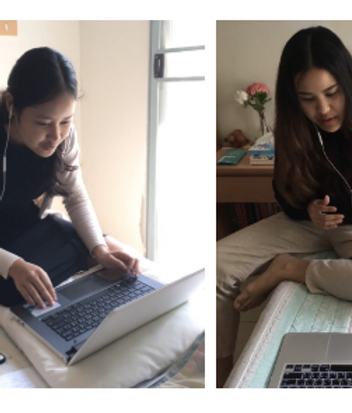
The voice recording process took place at Pat's dorm because we need a quiet place to do this step. After reading the dialogue, we divided the lines and rehearse for one to two times before spending an hour recording our voices.
It was fun to narrate the story and try to stick with the character he or she is. The most challenging part is when one person gets to be more than 3 characters, which we have to change our voices and mood to match with the situation and character.

Here it comes to my part where I have to edit the sound of our voices and mix with the sound effects to make it more realistic. This editing took two days to finish it.
I chose the iMovie program to edit the sound. However, in the beginning, I planned to use the Audacity program but the program did not support the file of voice records and it would consume a lot of time to convert the file so I changed the plan to iMovie.

Testing
We sent the prototype online and offline to 6 people
including university students, high school students, parents.
Here is the feedback that we added in a feedback capture grid.

Conclusion
Empathy happens when you understand a person from what she has experienced, which is not easy especially when you have never had that experience before. The same as people who are bullied by others about their body shape (aka. Body shaming), people that make fun of them might not know what the victims feel; they just unintentionally or intentionally say words that actually harm the listeners. The in-ear story brought the experience of the person who has been bullied on this topic and added additional detail to create a story that communicates the experiences of the victim to audiences. According to the feedback, the design has successfully build empathy for the audience through the realistic sound and story that engages the audience as a part of the movie.